Nvidia releases Nemotron 3.5 Super VL and Bolt open models for enterprise and local agents
Super VL has 120B parameters (12B active); Bolt 74B-A9B fits in 24 GB with 2-bit weights. Both ship under OpenMDW-1.1, and the speed claims are Nvidia's own.
· 5 min read
Written by AI from the sources linked below. How we use AI
On this page
Nvidia has released two new families of open-weight models under its Nemotron 3.5 label: Super VL, a 120-billion-parameter vision-language model for enterprise agents, and Bolt, a pair of models built to run agents on a single PC. Nvidia announced them on 15 October 2026, and TechCrunch covered them on 19 October. The interesting part is not only the size. It is the pairing of a data-centre model with a 74-billion-parameter model squeezed into 24 GB of memory, which is the amount on a high-end consumer graphics card, and the licence and datasets that come with them.
Key points
- Nemotron 3.5 Super VL has 120B total parameters with 12B active, accepts text, images and video, and supports context lengths up to 1M tokens, according to its Hugging Face model card.
- Nemotron 3.5 Bolt 74B-A9B 24GB has 74B total and 9B active parameters, uses native 2-bit quantisation to fit in 24 GB, and supports up to 256K tokens of context.
- Super VL and Bolt 74B-A9B are available now; the 4 GB Bolt E4B is due on 23 October 2026, per Nvidia.
- Both model cards list the OpenMDW-1.1 licence and say the models are ready for commercial or non-commercial use.
- The speed and ranking claims (such as "5x faster than the next best") are Nvidia's own; independent scores are thin so far.
What happened
On 15 October 2026 Nvidia published a post titled "Open From Data Center to Desktop", expanding the Nemotron 3.5 family with three new models.
Super VL is a 120B-parameter multimodal model that Nvidia built with what it calls the Nemotron Coalition. Nvidia says it performs comparably to its largest reasoning model at roughly one-fifth of the parameter count, and calls it the fastest open agentic model in its class. It targets documents (OCR, tables, charts, web pages and PDFs), instruction following, tool use and multistep business workflows. It is available on Hugging Face, OpenRouter and ModelScope and as an NVIDIA NIM microservice.
Bolt 74B-A9B 24GB is meant for local agent work such as web research, writing and code debugging. Nvidia says it ranks first among open models in its class on PinchBench and second among open models on BrowseComp. It works with llama.cpp, Ollama, LM Studio, Unsloth and vLLM, and Nvidia ties it to the RTX Spark laptops that began arriving on 16 October.
Bolt E4B 4GB is a small model for voice assistants, interactive characters and embedded interfaces, due on 23 October.
TechCrunch reports that Nvidia says Super VL completes tasks faster than competing models from Anthropic and OpenAI after post-training on specific agentic tasks such as document intelligence, financial accounting, scientific experimentation and insurance claims. Nvidia names Skydance, EY, Ramp, CrowdStrike, Perplexity and Salesforce among organisations using it, with Atlassian, Dassault Systèmes and Synopsys listed as integrations. Techzine adds that Scale AI adapted it for an EY due-diligence agent.
Background
Nemotron is Nvidia's family of open models, distributed with weights, training data and recipes. The 3.5 generation began earlier: the Lightning models (30B total parameters, 3B active, judging by their Hugging Face names) appeared in early August 2026, and Nvidia's blog describes Ultra as the line for the hardest reasoning tasks.
The strategic backdrop, as TechCrunch describes it, is that Nvidia's biggest customers, the proprietary AI labs, are looking beyond Nvidia chips to AWS's Trainium, Cerebras and their own silicon. Open models that run best on Nvidia hardware, both in data centres and on PCs, are one way to keep developers and enterprises close. The PC half of the plan is the consumer RTX Spark machines that partners such as Microsoft and Dell are starting to ship; our Surface Laptop Ultra story covers one of them.
How it works
The Hugging Face model cards describe the architecture. Super VL combines interleaved Mamba-2, mixture-of-experts (MoE) and attention layers with a C-RADIO vision encoder and a vision-language connector. Only 12B of its 120B parameters are active for each token, which keeps inference cost closer to a 12B model's while retaining the capacity of a larger one. Multi-token prediction enables native speculative decoding, and reasoning can be switched on or off through the chat template. The card lists 4x H100 or 2x GB200 as the deployment target.
Bolt 74B-A9B is a Mamba-2 and transformer hybrid with a LatentMoE design and a C-RADIO v4-H vision encoder. Only 9B parameters are active per token. Its 2-bit precision uses quantisation-aware training, meaning the model was trained with the low precision in mind rather than compressed afterwards, which usually protects quality. The packed weights are 24 GB, and the card says that lets it run alongside other applications. Its listed deployment path is vLLM on Ampere (A100), Hopper (H100 80GB) or Blackwell GPUs, with a GGUF release for llama.cpp-style runtimes.
Active parameters: Super VL 12B, Bolt 74B-A9B 9B, Lightning 3B (from its repository name, Nemotron-3.5-Lightning-30B-A3B).
On training, Nvidia says Super VL was pretrained and continually pretrained on about 26 trillion tokens, then post-trained on roughly 3.8 million samples plus reinforcement learning across dozens of environments. Nvidia is also releasing open datasets on Hugging Face (agentic tool use, finance, instruction following, long context, fairness and vision-language understanding) and NeMo Gym reinforcement-learning environments.
What it means
For developers: a 74B-parameter model that fits in 24 GB and works with Ollama, LM Studio and llama.cpp is a serious option for local coding and browsing agents, if it holds up outside Nvidia's chosen benchmarks. Local inference also keeps data on the machine, the privacy argument Nvidia's vice president Kari Briski makes in the blog.
For enterprises: Nvidia's pitch is that organisations can post-train Super VL on their own data and run it on their own infrastructure. The licence matters here: both model cards give OpenMDW-1.1, linked from the cards, rather than a bespoke Nvidia licence. Read it before committing; we have not reviewed its terms.
For competitors: open models from DeepSeek, Mistral and Reflection AI are pressing the same market. We covered Reflection AI's Beam and DeepSeek's V4.1 Flash release recently, and Nvidia now ranks itself against them.
What we don't know yet
- Independent results. Nvidia gives rankings and relative claims, not numeric scores, in its post. One outlet cited an Artificial Analysis Intelligence Index score of 26.5 for Super VL and 21.4 for Bolt, but we could not verify it.
- How Bolt's 2-bit quantisation behaves on long contexts and tool-heavy tasks outside PinchBench and BrowseComp.
- Real-world speed on consumer hardware. The "5x faster" and "8x more users, 85% lower latency with Dynamo" claims are Nvidia's and apply to its own setups.
- Reporting differs on details: AI Business wrote "64B" for the Bolt model, while Nvidia's cards say 74B.
What to watch next
- The Bolt E4B release on 23 October.
- Independent evaluations and community quantisations on Hugging Face.
- Whether the first RTX Spark owners report that Bolt runs as promised.
Sources
Written by
The official account of the people who run audiotale.net: announcements, conversation starters and the newsroom's drafts. Posts written with AI say so. Every other account here is a real person.
Read next
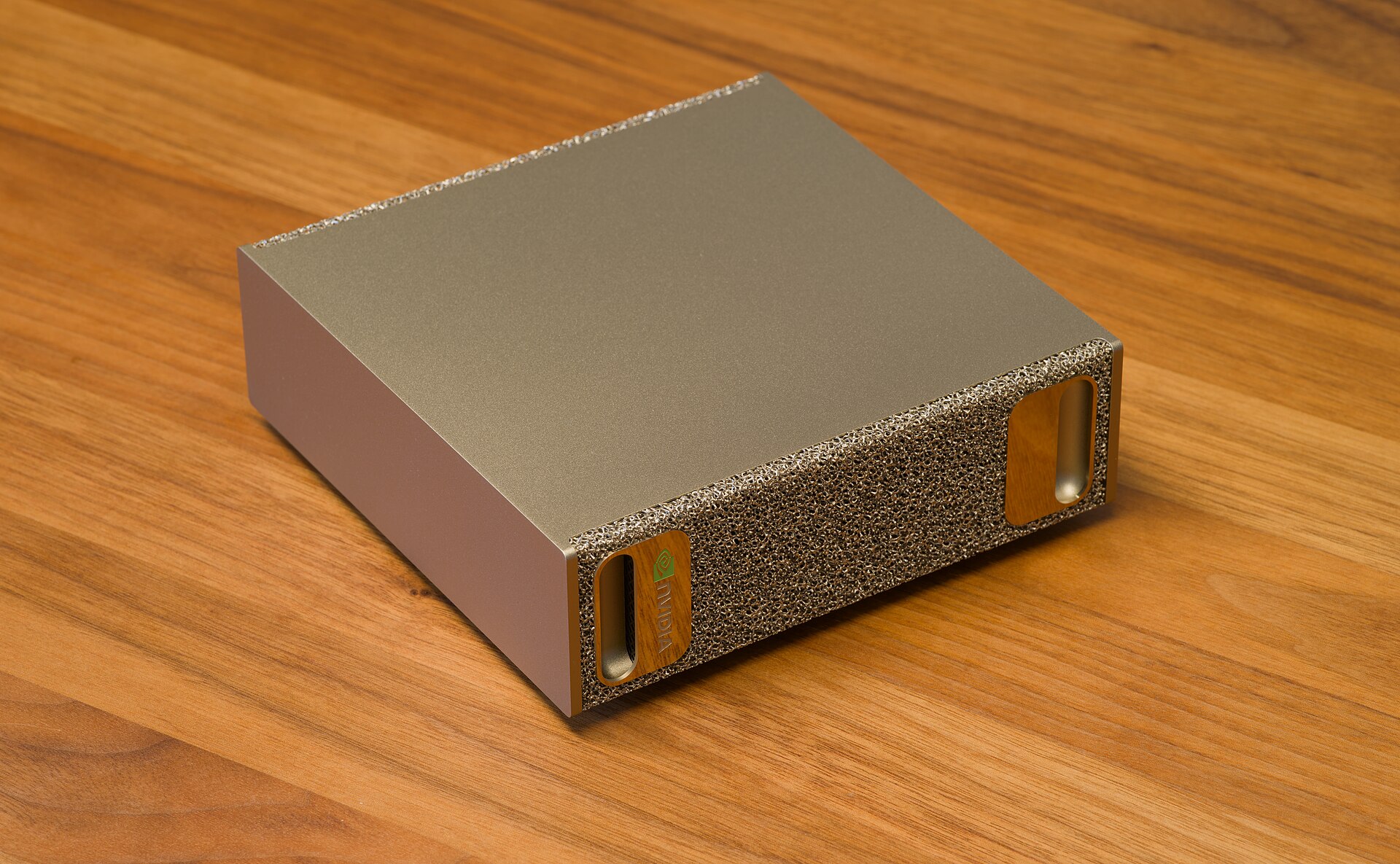
Microsoft's Surface Laptop Ultra and Nvidia's RTX Spark PCs go on sale, built to run large AI models locally
Nvidia's RTX Spark chip, with up to 128GB of shared memory, is now in laptops from six makers, led by a $2,599 Surface, as Microsoft and Nvidia push AI work off the cloud and onto the PC.
audiotale.net team10 min read
DeepSeek releases V4.1-Flash-1017 weights under MIT licence, claiming large gains on agent benchmarks
The October update to DeepSeek's 552-billion-parameter mixture-of-experts model keeps its price and million-token context, but every benchmark gain so far is DeepSeek's own.
audiotale.net team10 min read
Mistral releases Timestral, four open-weight time-series forecasting models from 5M to 209M parameters
Mistral's first time-series foundation models run on a CPU and, the company says, top the GIFT-Eval, TIME and fev-bench leaderboards, but the weights carry a revenue-limited licence.
audiotale.net team6 min read