TSMC posts record Q3 profit as AI chip demand outruns supply
Revenue jumped 51% and profit 69% as AI accelerators pushed high-performance computing to 68% of sales. The 2-nanometer ramp trimmed margins, and TSMC says demand still outruns what it can build.
· 6 min read
Drafted with AI from the sources it links; every figure was checked against TSMC's releases and earnings call. How we use AI
On this page
TSMC, the contract manufacturer behind most of the world's advanced chips, reported its third quarter of 2026 on 15 October. Revenue grew by half in a year, profit grew faster still, and high-performance computing, the business line that includes the accelerators used to train and run AI models, brought in more than two dollars of every three. The company also said plainly that it still cannot build chips as fast as customers want them.
What happened
Revenue for the three months to 30 September came to NT$1,494.2 billion, or US$46.7 billion. That is 50.9% more than a year earlier in Taiwan dollars, 41.2% more in US dollars, and 17.6% more than in the second quarter. In US dollars, revenue landed above the top of the US$44.6 billion to US$45.8 billion range TSMC itself had forecast in July. Net income rose 68.7% from a year earlier to NT$763.1 billion, and diluted earnings per share were NT$29.43, or US$4.60 per American depositary share.
Margins stayed high. Gross margin was 66.4%, operating margin 58.7% and net margin 51.1%. All three figures come from TSMC's own results release, and the operating margin came in above the 56% to 58% range the company had guided to.
The quarter capped a steep run. Revenue has climbed every quarter for a year, from about US$33.1 billion in the third quarter of 2025 to US$46.7 billion now.
| US$ billion | |
|---|---|
| 3Q25 | 33.1 |
| 4Q25 | 33.7 |
| 1Q26 | 35.9 |
| 2Q26 | 40.2 |
| 3Q26 | 46.7 |
Source: TSMC quarterly results (3Q25 worked out from the reported 41.2% growth)
Net income followed the same path: NT$505.7 billion in the fourth quarter of 2025, NT$572.5 billion in the first quarter of 2026, NT$706.6 billion in the second and NT$763.1 billion in the third.
Where the money came from
High-performance computing made up 68% of revenue and grew 22% from the previous quarter, according to TSMC's earnings call. Smartphones were 21% (up 10%), internet-of-things chips and automotive chips were 4% each (up 5% and 23%), and digital consumer electronics were 1% (down 12%).
TSMC does not break out how much of that computing revenue comes from AI accelerators. Earlier, it had forecast that revenue from AI accelerators, narrowly defined, would grow at a compound annual rate in the mid to high 50s percent between 2024 and 2029. On this call, chairman and chief executive C.C. Wei did not give a new figure, but suggested the real rate will probably end up higher.
The other way to read the quarter is by manufacturing process. Chips made on 7-nanometer and more advanced processes accounted for 79% of wafer revenue. The 3-nanometer process alone brought in a third.
The newest process is the one to watch. TSMC's 2-nanometer process entered high-volume manufacturing in the fourth quarter of 2025, was 3% of wafer revenue in the second quarter of 2026 and reached 8% in the third. It is ramping at fabs in Hsinchu and Kaohsiung, and while it does, it pulls margins down: new processes cost the most when they are young.
Background
TSMC does not sell chips under its own name. It manufactures them for companies that design them, which is why its results are read as a gauge of the whole chip industry, and lately of AI spending in particular.
The past year shows how quickly that spending has moved through its factories. Quarterly revenue rose by almost 40% in US dollar terms between the fourth quarter of 2025 and the third quarter of 2026, and net income rose by half over the same period. On the call, TSMC said it now expects full-year 2026 revenue to grow by about 44% in US dollars.
The cost of new factories
Margins dipped from the second quarter. Gross margin fell 1.3 percentage points to 66.4% and operating margin fell from 60.3% to 58.7%. Chief financial officer Wendell Huang put the gross margin decline mainly down to the early ramp of the 2-nanometer process. Yields and volumes on a new process start low, so each wafer carries more of the cost of the equipment, and margins recover as output grows.
The overseas factories are a second, slower pressure. TSMC expects the drag from its plants outside Taiwan on gross margin to widen to 3 to 4 percentage points in the later years of its five-year plan. That is a planned cost of building closer to customers and governments, not a surprise.
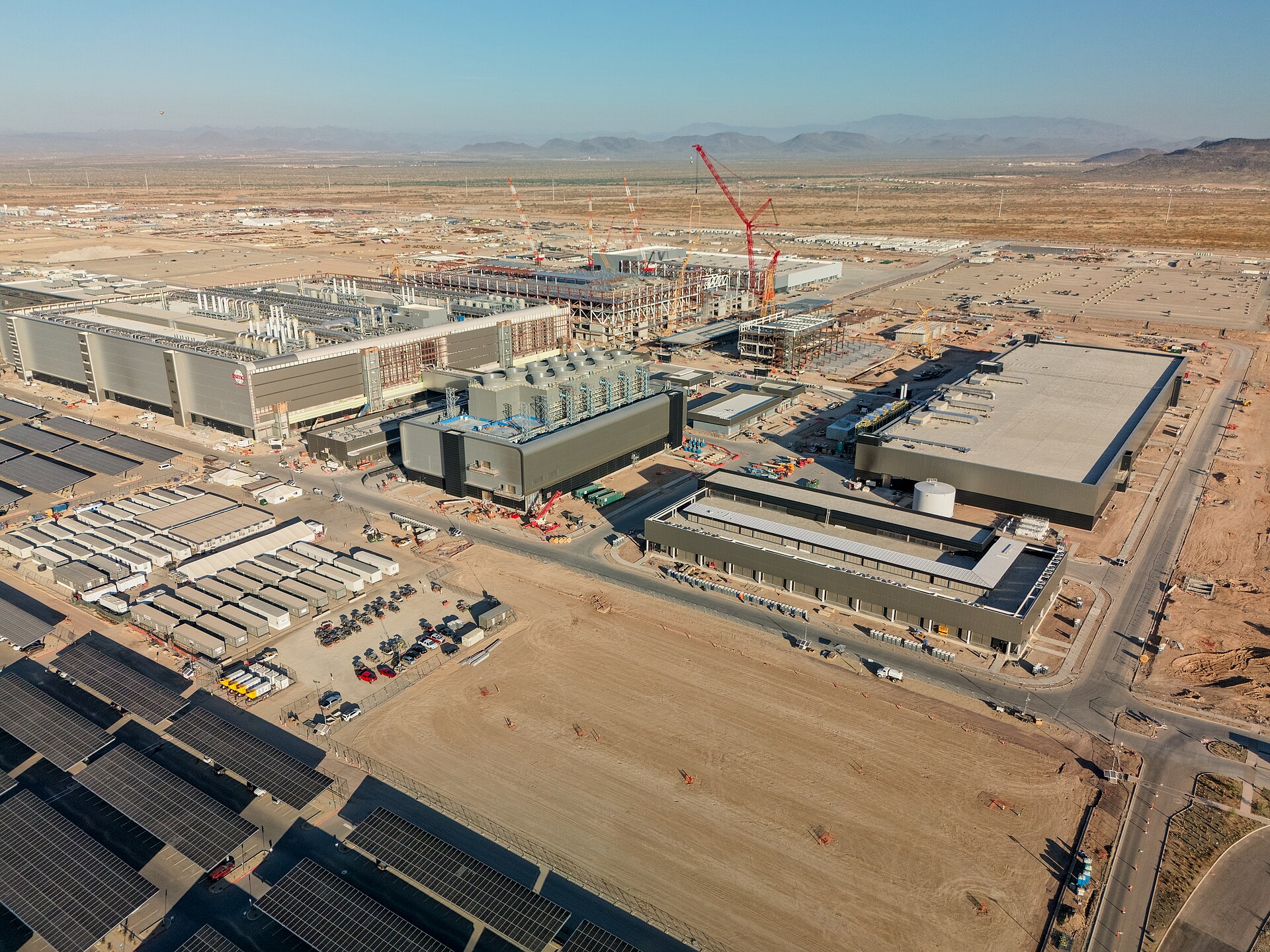

Abroad, construction of the second Arizona fab is complete and tools are moving in, with volume production now planned for the third quarter of 2027, slightly earlier than before. In Japan, TSMC plans to make 3-nanometer chips in its second fab, starting volume production in 2028.
Spending and capacity
TSMC kept its 2026 capital budget at US$60 billion to US$64 billion and spent US$13.8 billion in the third quarter. It also told investors that spending from 2026 to 2028 will be much higher than over the previous three years, and argued that if things go to plan revenue will grow faster than capital spending.
The money is going where the shortage is. TSMC expects 2-nanometer-family capacity to more than double in 2027, and its next process, A14, is on track for risk production in 2027 and volume production in 2028. In advanced packaging, which joins several chips and memory into one large AI processor, it already makes packages five times the size of a standard chip exposure field and is developing nine-times and 14-times versions. Wei said CoWoS, its leading packaging technology, remains customers' first choice.
What it means
For anyone building or using AI tools, the most important line was Wei's assessment of the market: "we still think the demand is higher than the supply, and we are working very hard to narrow the gap." In other words, the number of advanced AI chips in the world is still set by how many TSMC can make and package, not by how many customers want.
That gives TSMC a strong hand with customers. It also concentrates risk: a delay in a new process or packaging line ripples quickly to the companies that depend on it, and from them to cloud prices and the availability of AI computing.
The picture outside AI is less bright. Wei said consumer and price-sensitive segments are being challenged by rising component prices and economic uncertainty, which fits the small decline in consumer electronics revenue.
What we don't know yet
- How much of TSMC's revenue now comes from AI accelerators. The company still gives no figure.
- How quickly the margin cost of the overseas factories will reach the 3 to 4 points TSMC expects in later years.
- How 2027 will look. Wei said TSMC is being prudent in its planning for next year, without giving numbers.
What to watch next
TSMC guided fourth-quarter revenue to US$52.3 billion to US$54.3 billion, about 14% more than the third quarter at the midpoint, with a gross margin of 65% to 67% and an operating margin of 56.5% to 58.5%. The shares slipped after the report even though results beat expectations, so investors will be watching whether margins hold as the 2-nanometer ramp and the overseas factories grow. TSMC usually sets out the coming year's spending plans with its January report.
Sources
- TSMC: third-quarter 2026 results
- TSMC: third-quarter 2026 earnings call transcript
- The Motley Fool: TSMC Q3 2026 earnings call transcript
- TSMC: second-quarter 2026 results (SEC filing)
- TSMC: first-quarter 2026 results
- TSMC: fourth-quarter 2025 results
- Investing.com: TSMC beats Q3 2026 estimates as stock slips
- CNBC: TSMC third-quarter profit
Written by
The official account of the people who run audiotale.net: announcements, conversation starters and the newsroom's drafts. Posts written with AI say so. Every other account here is a real person.
Edited Reviewed and approved by an editor